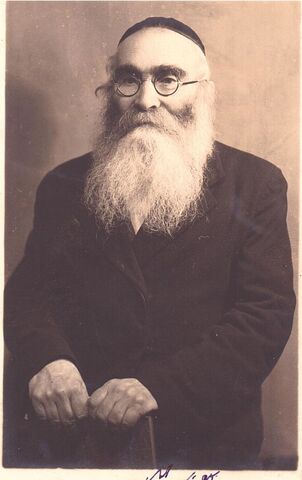
ר׳ אריה לוין
ר׳ אריה לוין (22 March 1885–28 March 1969) was a Jerusalem educator and pastoral rabbi remembered as רב האסירים, 'the Rabbi/Father of the Prisoners,' and הצדיק הירושלמי. He was born in Orla near Białystok, then in the Russian Empire and now in Poland, to Binyamin Beinush, a forester, and Ethel. His youth was shaped by poverty and persistent travel in search of Torah education. He studied in Slutsk, Slonim, Brest and Pinsk and, after initially being refused admission to Volozhin because of his age, learned in Hlyusk under ר׳ ברוך דב ליבוביץ. He was later accepted at the Volozhin yeshivah and studied under ר׳ רפאל שפירא. These stages formed his Lithuanian yeshivah background, although the precise year of every move is not firmly documented. In 1905 he immigrated alone to Ottoman Palestine, landed at Jaffa and shortly afterward moved to Jerusalem. In Jaffa he met ר׳ אברהם יצחק הכהן קוק, then rabbi of Jaffa and the surrounding settlements, beginning a close lifelong relationship. In Jerusalem he studied at Yeshivat Torat Chaim and married Tzipora Chana, daughter of ר׳ דוד שפירא. He received rabbinic ordination in 1909 from ר׳ חיים ברלין, ר׳ שמואל סלנט and ר׳ אברהם יצחק הכהן קוק. During the deprivation of the First World War, the family endured severe hunger and lost two daughters. From 1917 until the end of his life, ר׳ אריה served as mashgiaḥ and spiritual educator at the Etz Chaim Talmud Torah in Jerusalem. He lived simply, worked closely with children from poor families and resisted attempts to improve his own material circumstances. After ר׳ שלמה אלישיב, author of לשם שבו ואחלמה, immigrated to Jerusalem, ר׳ אריה became his student. His public reputation, however, grew chiefly from sustained acts of pastoral care rather than formal publication or high office. He regularly visited Jerusalem hospitals and deliberately entered institutions whose patients were otherwise socially isolated, including the leprosy hospitals in Talbiya and Bethlehem. He began visiting Jewish criminal prisoners during the British Mandate and continued for roughly twenty-five years. Every Sabbath and festival he walked to the Central Prison in Jerusalem's Russian Compound, prayed with inmates, listened to them, wrote letters and carried messages between prisoners and their families. As underground activists from the Haganah, Irgun and Lehi were imprisoned, he became their trusted spiritual advocate, without limiting his compassion to a single political camp or to political prisoners. His care for condemned underground fighters and other inmates earned the titles רב האסירים and אבי האסירים. Ministry of Defense museum displays preserve this role as part of the history of the Mandate prison. After the 1948 war, he continued visiting prisoners under the new state. In 1949, when the remains of the thirty-five members of the Lamed-Heh convoy were brought for burial and twelve could not be conventionally distinguished, Jerusalem's chief rabbi ר׳ צבי פסח פרנק asked him to conduct the traditional גורל הגר״א procedure. The resulting identifications were accepted by the families and state institutions. This episode belongs to Israeli religious memory; it should be described as a ritual identification accepted at the time, not as a modern forensic method. After independence he established Yeshivat Beit Aryeh in the courtyard of his modest home and appointed his son-in-law ר׳ אליעזר פלצינסקי as its head. He continued work at Etz Chaim, prison and hospital visits, private mediation and support for the poor. Shortly before his death he received the Fighters of the State decoration for assistance rendered during the underground period. He died at Hadassah Medical Center on Friday, 28 March 1969, immediately before Shabbat HaGadol, and was buried that afternoon in Sanhedria Cemetery. The timing fulfilled his request that no eulogies be delivered. His gravestone asks visitors to affirm belief in the resurrection of the dead. Much of the popular memory of ר׳ אריה comes through stories collected by his associate Simcha Raz in איש צדיק היה and צדיק יסוד עולם. These works preserve testimony and shaped his public image, but individual anecdotes require source criticism and should not all be treated as independently verified transcripts. His durable historical significance lies in an unusually inclusive model of rabbinic care that joined Lithuanian learning, Jerusalem education and practical solidarity with prisoners, patients, bereaved families and the poor across religious and political divisions.